How Do Depictions of Royalty Differ From Those of Others in Ancient Egyptian Art
To understand and capeesh Egyptian fine art ane must look at the beginnings of art in Egypt and how it developed, for in that development lay the roots of many ideas and techniques. This resources explores this evolution.
The Paleolithic beginnings
One can be forgiven for thinking that Egyptian fine art is all about colour, strange statues, temples and mummies, but its art starts 15,000 years ago in the Upper Palaeolithic period.
- What types of artefacts have been found that shows the presence of art in Arab republic of egypt?
- Was the stone art found in caves or out in the open up?
- Were they painted on to the rock?
A number of Palaeolithic sites of rock art and etchings have been discovered. Abreast the rock drawings there is evidence of simple weaving of threads and wood.
One set of this rock art was discovered in 1962 at Qurta on the Kom Ombo evidently, South Egypt, past archaeologists from the University of Toronto, Canada. The site was rediscovered in 2005. Curiously these are similar in age and style to the Palaeolithic cave art in Lascaux, France, and Altamira, Kingdom of spain. More than examples of rock fine art were discovered in 2004 at Abu Tanqura Bahari at Al-Hosh, about 10 kilometres to the north and on the opposite banking company of the river and in 2007 in Upper Egypt, Al-Ahram.
- What were the subjects of the Egyptian stone art?
The engravings found in 1962 on the Kom Ombo patently consist of more than than 160 figures and describe mostly wild bulls, the biggest nearly two metres wide. They were categorical into several sandstone cliff faces at the village of Qurta, about 400 miles (640 kilometres) south of Cairo. All the rock art images are very darkly coloured and seem to be covered past a varnish. Most of the images also take traces of intensive weathering through wind or Aeolian abrasion and water run-off.
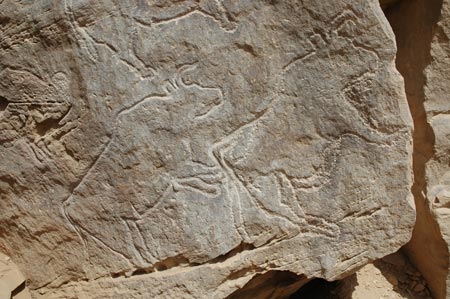
Figure 1: Rock drawing of cattle. © Dirk Huyge, RMAH, Brussels
The cattle are drawn and painted in a naturalistic way quite unlike from those shown in cattle representations of the later Classical period. There are illustrations of hippopotami, fish, and birds and interestingly human being figures tin can be seen on the surface of some of the rocks. This could hateful the Egyptian people of this time were using art to venerate animals, to instruct young on hunting or to record their environment.
Understanding Egyptian Palaeolithic art
To date the drawings they were first examined for patination andweathering. This suggests these drawings are extremely old. They were and so examined for lichens and organic grime called "varnish rind", which could be radiocarbon datedor subjected to uranium series dating. The dates from these tests evidence them to exist around 15,000 years quondam. Finding stone art from this period and in this style leaves us with a big question:
- Were the people in Western Europe and those in Southern Egypt producing almost identical artwork at the same time in history?
The art is so alike it reflects a similar mentality, maybe a parallel phase of cultural development.
- Was it considering the people were confronted with similar conditions and this lead to a similar fashion of creativity?
Arab republic of egypt lies on the road from the Rift Valley of Africa upwardly to the Arabian Peninsula, which was the route of modern man from their evolutionary beginnings in Africa, and then with those questions in listen it is reasonable to speculate that there could have been similarities in the development of culture.
How did they produce the rock fine art?
These Egyptian Palaeolithic artists used a special artistic technique to engrave and paint their rock images. They hammered and incised the solid surface to transform it into a fine animal, a bird or a scene from the nature around them. In some cases the figures are executed virtually in bas-relief. They made utilize of natural fissures, cracks, curves, arches and brows of the rocks, and integrated them into the art images. The fauna of these Late Palaeolithic sites on the Kom Ombo patently propose a culture of hunters and fishermen.
Even though there are drawings that testify superimpositions all announced to exist of the aforementioned phase and the animals all appear to be single animals and of wild, non domesticated, species. Quite ofttimes the heads of the cattle are represented either up or downwards every bit if they were being represented in motility.
Ancient Arab republic of egypt was a gift of the Nile. The almanac flooding, known as the flood, brought life to the peoples settled forth its banks. Therefore it would be reasonable to consider life on the river would figure high in the behavior and consequently in the art of the people. Hunting and line-fishing predominated and so the people represented this in their fine art.
What is articulate is that Egyptian art is evident in the Palaeolithic Period, well before the Classical Egyptians, and that the forces driving this art lie in the environment.
Palaeolithic fine art develops into the Badarian civilisation
Later on the Palaeolithic period the next art grade is from the Badarian, an agrarian culture. They provide us with the earliest direct evidence of the development of agriculture in Upper Egypt and flourished between 4400 and 4000 BCE. Information technology illustrates a motility abroad from dependence upon hunting and line-fishing that was first identified in El-Badari, Asyut (Figure ii), where about forty settlements and six hundred graves were located.
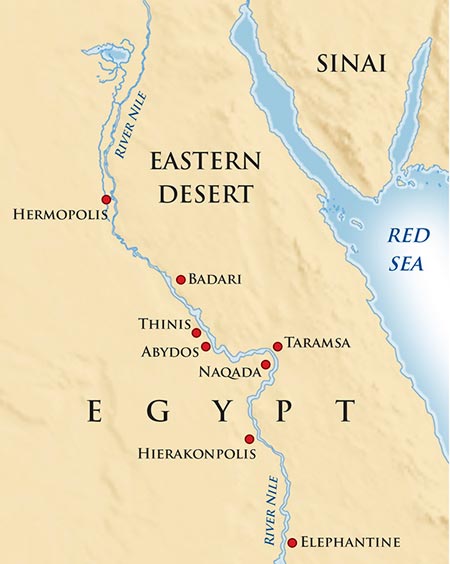
Figure 2: Map of the Bardari culture. Peter Bull
The Badarian economy was based mostly on agriculture, fishing and animal husbandry and that is seen in almost of the tools institute as grave goods. These include scrapers, perforators, axes, sickles and concave-base arrowheads many of which were functional and show picayune decoration.
- Were the Palaeolithic peoples art similar to the succeeding Badarian People?
Badarian art and craft
Badarian artefacts found were simple handmade pots made from Nile silt, containing small quantities of sand that could have been added deliberately. The pots are decorated with ripples or small-scale waves; probably the event of combing and polishing the clay. They are fine pieces of work. The pots were made using mud coils stacked on summit of each other and polished to form shine walls. This fashioned walls that are the thinnest seen in whatsoever of the Egyptian period. Potters stabilised their pots by calculation a ridge on the base of operations to make carinated pots. This allowed the circular pot to stand upright (see Figure 3).
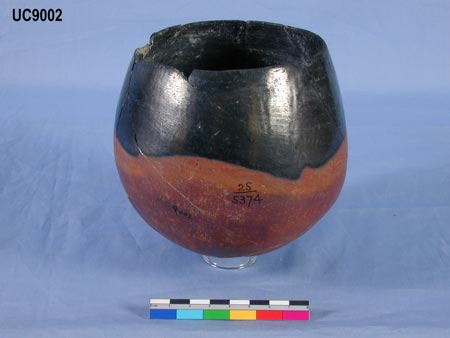
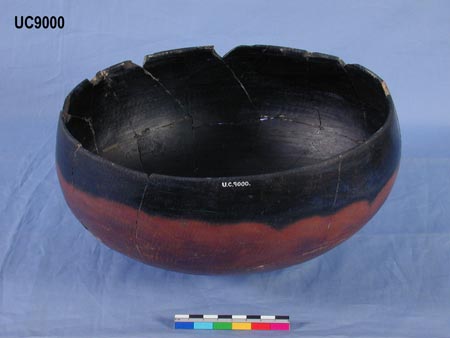
Figure three: Badarian pottery well-nigh 4500 BCE. Image courtesy of the Petrie Museum of Egyptian Archaeology
The pots were probably fired in open pits since no kilns have been found. Some pots show the utilise of a chocolate-brown-blackness sideslip to the meridian of the pot, probably achieved by placing the peak of the pot upside downwards into the embers of a burn down to produce the reducing conditions. All this shows a methodical approach to pottery and the development of an art and craft.
- Was pottery the only forms of artefacts found?
Other things found in the graves include such things as hairpins, combs, bracelets, beads of ivory and bone and female statuettes made of ivory or clay. On the bodies were found amulets some with animate being heads, similar gazelle and hippopotami.
- Could the ornament be an indication of fauna veneration, or a desire for protection from danger?
- Is the fine art playing a role in representing those beliefs?
The dead were placed in the foetal position on woven mats and buried in pits with grave goods laid around them but in no specific pattern. Their heads were by and large laid to the South, looking west towards the setting sun.
- Could this bespeak a sense of rebirth in their faith?
Minerals, pigments and metals
On some male bodies in that location accept been found girdles made of steatite (soapstone). Steatite is a talc-schist; a type of metamorphic rock largely composed of the mineral talc and rich in magnesium. It occurs in areas where tectonic plates are subducted (where a tectonic plate slides under another). The heat, pressure and influx of fluids modify the rocks merely without melting them. Such an area lies forth the Eastern Desert so in that location was active collection of special rocks there, or trading for them.
There is show of pigment grinding such as the green mineral malachite possibly for corrective use. This is shown in the number of greywacke rectangular or oval palettes (used for mixing pigments and oils) found in the grave goods.
Also found in the graves were Red Sea seashells, slates, wood and hammered copper showing an emergent metal arts and crafts. The nearest copper ores of green malachite are in the Eastern Desert and the Sinai so nosotros tin deduce the copper, some forest, slate and seashells can be indicators of contact with other cultures and peradventure trading.
There are also reports of small beads of turquoise; a rare mineral that could point to turquoise existence used as jewellery. Turquoise is an opaque, blue-to-greenish mineral that is a hydrous phosphate of copper and aluminium, (CuAlvi(PO4)4(OH)8·4HiiO). It is rare and valuable and has been prized as a gem and ornamental stone for thousands of years owing to its unique hue.
- Does trading signal that the Badarian order was developing a civilisation?
Developing Egyptian guild
From the grave bear witness there appears to have been social stratification in that the wealthier seem to have been buried in a separate office of the burial ground and the manner and type of goods indicates their wealth. Egyptian society was developing a construction that could exist based upon wealth and goods were becoming a brandish of that wealth through the ornament displayed on them.
What nosotros run across here is the beginnings of the development of a more than sophisticated lodge where art is kickoff to play a office in more than a belief course. It is being used as a mark of identity and belonging to a particular section of club.
Badarian to the Naqada I Culture
During the Neolithic Period in that location was a change in the cultures of Egypt. The Naqada (4000-2920 BCE) culture seems to have overlapped with the Badarian civilization and developed some parallels but as well differences.
In the Naqada civilisation we find fine art in varied forms and to distinguish the developments it is divided into three periods; Naqada I (Amratian 4000-3500 BCE), Naqada II (Gerzean 3500-3100 BCE) and Naqada III (3100-2920 BCE).
- Were there differences in the art from each of the 3 Naqada cultures?
The Naqada I Amratian culture was an agrarian one just dissimilar from the Badarian in that they mastered the use of bogus irrigation and then important in the Nile river valley. They no longer needed to hunt for nutrient. They grew and harvested crops and kept cattle, simply more important they moved from small settlements and started living in towns, creating areas of higher population density.
- Would this indicate the need for greater social stratification and possibly a hierarchy?
Grave goods
The burial rites continued to be similar to those of the Badarian civilisation with the range of grave goods being greater. The burials indicate more social diversity and the grave appurtenances are designed to indicate the identity of the deceased. They were generally single burials but there are some multiple burials especially female parent and infant. There is the continued utilise of the funerary mat and the caput is often laid on a pillow.
Many of the skeletal remains take the remains of a textile loincloth merely some accept an animal hide loincloth trimmed with fabric. This could bespeak a developing fashion form linked to some social diversity in the population but it is non possible to determine any bureaucracy.
At that place are funerary statuettes of both men and women but interestingly they are rarely shown seated. They are generally standing with an emphasis on the sexual characteristics. When plant it is mostly as a single or group of two statuettes rarely more three.
The Naqada culture developed their artistic tendencies, creating new styles of pottery and more intricate etching. The black reddish pottery show signs of high polish and over time the ripple or wave pattern seen in the Badarian disappeared replaced by white designs depicting animals and vegetation alongside geometric shapes see Figure 4 below.
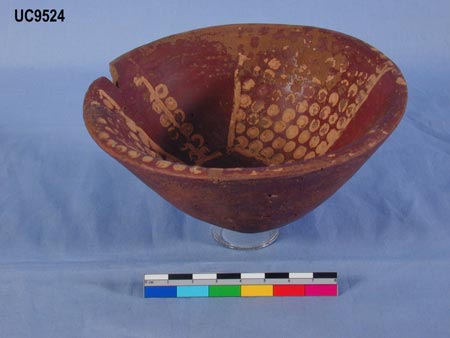
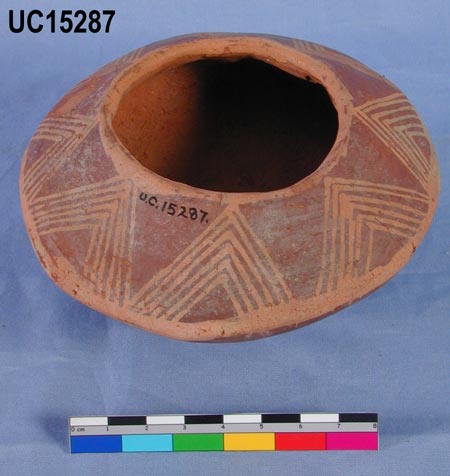
Effigy 4: Naqada I pots. Image courtesy of the Petrie Museum of Egyptian Archeology, UCL, UC9524 and UC15287.
Palettes
Many stones take been found that had been used for grinding pigments and these developed into more formal objects chosen palettes. Many palettes take been found in a rhomboid shape (see Figure 5) and some animal and shield-shaped palettes accept been recovered that show a articulate link in development towards the ceremonial palettes of the early dynastic menses.
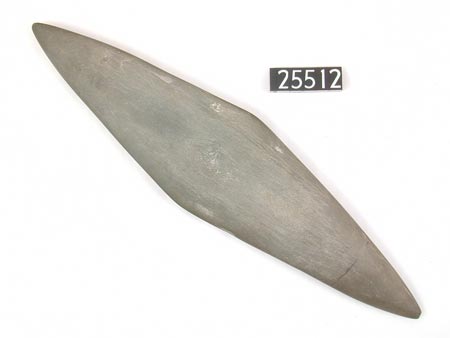
Figure 5: Rhomboid palette. Image courtesy of the Petrie Museum of Egyptian Archaeology, UCL, UC25512.
Although hunting was no long important for food it was oft constitute engraved or carved on the palettes. Another important delineation is the victorious warrior. This seems to signal that hunting and organised war parties were not a normal part of the everyday life but had get a part of the culture of status.
The creature represented on the hunting palettes and containers tended to reverberate the importance of the Nile to the people in that there were more river creatures shown such as crocodiles, hippopotami, flamingos and lizards. Likewise as cattle, land animals were also represented such as giraffes, gazelles and scorpions. Human forms were drawn only frequently equally schematics with small features.
- What makes the Naqada culture so different from the Badarian?
Working with metals, stones and minerals
The Naqada I developed their skills in metal-working, in particular copper. Copper and flint knives were plant in the graves of high status Naqada I people as were disc-shaped hard stone mace heads. At that place are a high number of tools such as punches, needles, awls, combs, spoons and an ivory pot, stone vessels and several meteoritic fe beads. Some of these, especially the ivory combs, have been decorated with animal and man forms.
There was show of attempts at faience, where crushed quartz is mixed into a paste and shaped then coated with natron glazes coloured by metal oxides. Natron is a white to colourless mineral, a naturally occurring mixture of sodium carbonate decahydrate (Na2CO3·10H2O) and well-nigh 17% sodium bicarbonate (NaHCOthree) forth with small quantities of sodium chloride and sodium sulfate.
Natron deposits are plant in saline lake beds in arid environments and were harvested direct as a salt mixture from dry lake beds in Ancient Egypt. It was used as a cleaning material and blended with oil to class an early type of soap. The mineral was used every bit an early on antiseptic for wounds and small cuts. Natron tin be used to dry and preserve fish and meat and later was after used in the mummification processes.
Trading
The Naqada I traded with the people in Syria/Palestine, Nubia, Mesopotamia and Asia equally demonstrated by the finding of the blue mineral lapis lazuli in the grade of beads. This lapis came from its only known prehistoric source Badakshan, in north-eastern Transitional islamic state of afghanistan.
The introduction of cylindrical seals (a typically Mesopotamian device) showed that their culture was influenced by their neighbours. Significantly the faith seems to take become more than abstract and the familiar Egyptian gods, Hathor, Ra and Horus, date to this period.
What is becoming clear is that in the Naqada I period in that location were urban centres that brought together the workshops, craftsmen, and the facilities for commercial exchange; the organisation of arts and crafts to create a lodge with an art civilization that is beingness used for religious and fashion purposes.
Naqada 2
During the Naqada II (3500-3100 BCE) at that place were more than interesting developments in art and craft. Geographically the northward (known equally Lower Arab republic of egypt) and south (known equally Upper Arab republic of egypt) remained separate and developed independently. The southward displayed very distinctive artistic forms, specialised crafts and religious belief.
- What marks the Naqada 2 culture as different from Naqada I?
The differences can be seen in the burial goods. In the British Museum we find Ginger (Figure 6), a Predynastic man from the Naqada Ii Catamenia (3200 BCE). Ginger was buried in the sand with some of his favourite possessions and the dry weather of the desert mummified his torso. He is surrounded by a range of different pots and a palette.
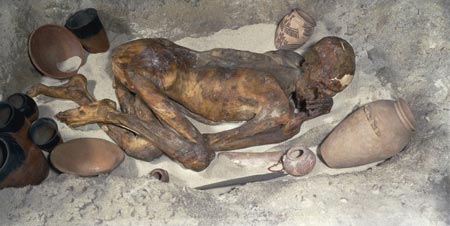
Figure 6: 'Ginger' Gebelein Man. © The Trustees of the British Museum
It is in the burial and funerary practises that the changes can be seen indicating changes in the religious beliefs. There is an increased number and range of grave appurtenances, many decorated and they are now laid out in formal patterns. Later, these burial rites included starting to wrap the body and much afterward the use of coffins.
- Does this display a stronger belief in an afterlife, specific burial rituals and the need of the deceased for these items in that afterlife?
The people continued to alive in settlements just the towns became bigger surrounded by smaller villages and within the towns there was consolidation of resources and zones of people with particular skills. Specialised crafts workers were employed in workshops to produce items for the use of an increasingly small department of lodge. Art is clearly taking on two roles; art for religious purposes perhaps with a ritual and art for status.
There are new types of pottery using marl, a friable or crumbly earthy deposit consisting of clay and calcium carbonate. New decorative styles were also used such as lite coloured vessels painted in carmine with a standard organised decoration of both geometric and figurative images, every bit seen in Figure seven beneath.
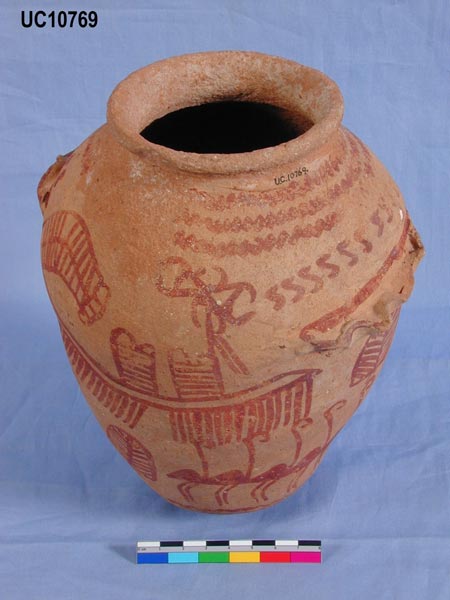
Effigy vii: Decorated pots. Image courtesy of the Petrie Museum of Egyptian Archæology, UCL, UC10769.
There are as well examples of carved statuettes of human figures from the Naqada I and Ii periods, but many have footling provenance so it is difficult to confirm their date.
Decorative palettes
The Naqada II continues to use palettes but the decoration becomes more elaborate and one of the nearly spectacular features is the increased number of cosmetic palettes that have been found in tombs.
- What made the Naqada Ii palettes different from Naqada I?
The Naqada I palettes were generally rhomboid pieces of shale or schist used to grind pigments before awarding to the body. In the Naqada Ii period they became more than sophisticated but simple in design such equally either a fish or a double headed Bird, Figure viii below.
- Is this an indication of a more ritual rather than cosmetic use of the palette?
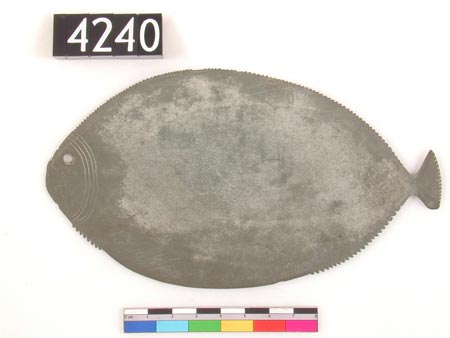
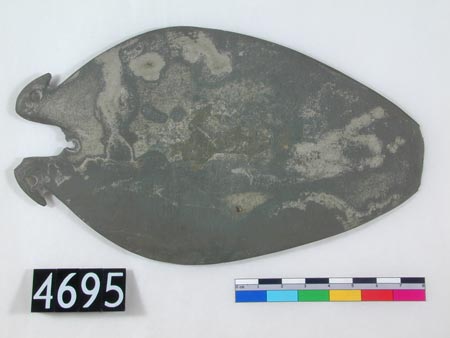
Figure eight: Two examples of Naqada II corrective palettes. Paradigm courtesy of the Petrie Museum of Egyptian Archeology, UCL, UC4240 and UC4695.
There is the establishment of a well-divers copper industry (for the production of both tools and jewellery), with increased gold and silver working for jewellery.
This caste of change seems to signal there has been an increased contact with other cultures and this can exist seen in the range of pottery from Palestine and Mesopotamia. This reflects the growing complication of the social structure, which is both more diversified and more hierarchical.
The Aboriginal Egyptian fascination with representation and fine art clearly appointment to this time. Although the character of expressive art has been irresolute from the Palaeolithic we can meet the skills learnt are being built upon. Information technology is to this fourth dimension that some of the Dynastic themes were established similar cattle and gunkhole motifs, for example, and perhaps even the primeval precursors of hieroglyphic characters.
Predynastic art – Naqada III
It is conjectured the Naqada II adult into the Naqada III (3100-2920 BCE) and this formed the foundation of the Classical Egyptian art. Information technology was also during this period that the unification of Upper and Lower Arab republic of egypt into i country took place with named kings. Hence information technology is often referred to as Dynasty 0 or Proto-dynastic Menstruum.
- Why is the Naqada Iii culture considered the most important for development of the Classical Egyptian fine art civilisation?
From Naqada Three Egyptian fine art continued to develop but they never had a concept or give-and-take for art since the art was closely woven in with the faith.
Hieroglyphs
With unification Egyptian art was characterised by the development of stylised pictures as advice in the form of hieroglyphs, which were establish on a number of different objects including palettes. On the Narmer Palette (31st century BCE), a pregnant archaeological find, nosotros discover one of the kickoff graphical narratives in the form of a pictorial language. Information technology tells a story with its two sides of raised relief decoration containing some of the earliest hieroglyphic inscriptions. Information technology is carved from a single flat piece of soft nighttime grey-dark-green siltstone (encounter Figure nine beneath).
It is thought by many Egyptologists to show the unification of Upper and Lower Arab republic of egypt nether the male monarch Narmer. On ane side, the king is depicted with the bulbous White Crown of Upper (southern) Egypt (Smiting side), and the other side (Serpopard side) depicts the rex wearing the level pointed Blood-red Crown of Lower (northern) Egypt.
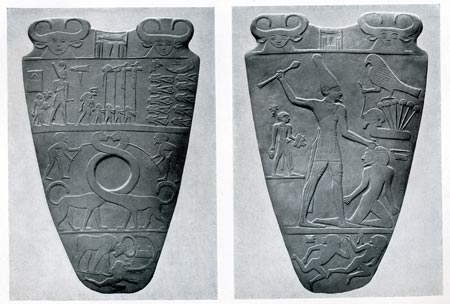
Figure ix: Namer Palette (31st Century BCE), The Smiting side and the the serpopard side. Serpopard is a mythological creature, from the words 'serpent' and 'leopard'. © Ivy Close Images / Alamy.
Palettes were typically used for grinding cosmetics, but this palette is too big, heavy and elaborate for personal apply so information technology is reasonable to consider it a ritual or votive object, specially fabricated for utilize in a temple. One theory is that information technology was used to grind pigments to beautify the statues of the gods.
Stoneworking and metalworking
It was too during the Naqada III catamenia that stone working was developed. They worked with increasing skill with limestones, alabasters, marbles, serpentine, basalt, breccias, gneiss, diorite and gabbro.
The Naqada Iii period too saw the intense working of copper to produce larger tools such equally axes and blades, besides as for bracelets and rings. Aslope copper they worked more than with aureate and silver.
Naqada III saw the development of a class of artisans specialised in producing artefacts for an elite and for religious purposes.
The stage is gear up for the Classical Egyptian period of fine art. The skills take adult and many of the embryonic symbolism take been established.
Classical Egyptian art (2920 BCE - 332 CE)
Introduction
Egyptian art comes to the fore from the end of the Naqada Three catamenia and similar the Naqada there a number of different chronological periods during the time from 2686 BCE - 395 CE: the Old Kingdom, Showtime Intermediate Kingdom, Middle Kingdom, 2d Intermediate Kingdom, New Kingdom, Tertiary Intermediate Kingdom, Late Period, Ptolemaic and Roman Menstruum. The Ptolemaic and Roman is oftentimes referred to as the Greco-Roman Period.
- What forms of art can nosotros come across in the Egyptian menstruum?
Classical Egyptian fine art is the painting, sculpture, architecture and other arts produced by the culture of Aboriginal Egypt in the lower Nile Valley. In a narrow sense, Ancient Egyptian art refers to the canonical 2d and 3rd Dynasty art adult in Egypt from 3000 BCE and used until the 2nd century.
Because many of the elements of Egyptian art had been developed over time, the Classical period began with a set up of skills that allowed most of Egyptian art to remain remarkably stable over a 3000 yr period. This was besides possible considering there was relatively footling exterior influence.
The quality of observation and execution started at a high level and remained at that level in painting and sculpture. It was both highly stylised and symbolic. Much of the surviving art comes from tombs and monuments and so there is an emphasis on life after death and the preservation of knowledge of the by. However at that place are other art forms such as paintings of everyday life.
Portraiture was highly developed, especially that of royalty, representing a complicated mixture of realistic delineation of individuals and stylisation of grade.
Colour in Egyptian art was formalised into those for naturalistic paintings (landscapes, daily life and travel stories) and those for religious (funerary and medical art). For naturalistic paintings the artist could mix and superimpose colours at will. In the religious fine art at that place was a palette of merely six colours, each colour linked to specific symbols and precious metals that meant mixing would render them meaningless. They were used in juxtaposition to each other.
Egyptian art
From the myths of creation we tin can deduce that the art of the Egyptians served a vastly different purpose than that of afterward cultures. Generally, the works nosotros see on brandish in museums were products of royal or elite workshops. These pieces fit all-time with our artful sense of art. At that place are other items from the common people only, even here, there is the influence of their beliefs.
To sympathize Egyptian fine art one needs to take some thought of the myths of the Ancient Egyptians.
While nosotros marvel at the beautiful treasures in museums, reliefs from New Kingdom tombs, and statues from the Old Kingdom, it is important to remember that the majority of these works were never intended to be seen. These images, statues and reliefs were designed to do good a divine or deceased recipient. Statuary provided a place for the recipient to manifest and receive the benefit of ritual actions. Reliefs were oft instructions or stories for the underworld.
a)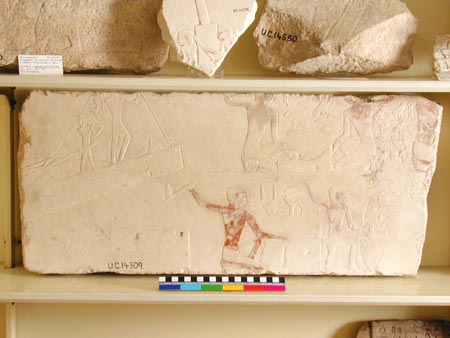 b)
b)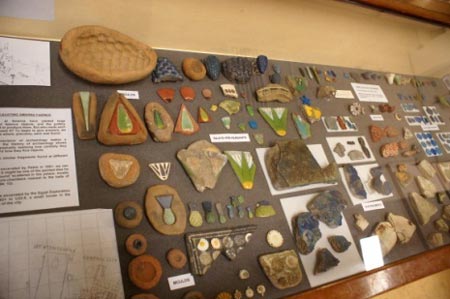
c)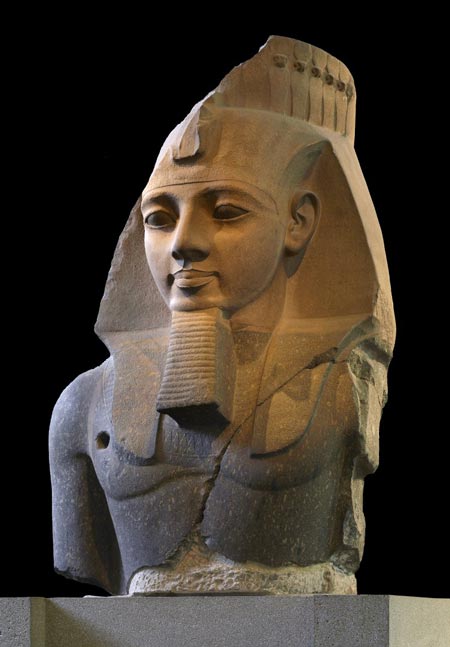
Figure 10: Examples of Egyptian Fine art: a) reliefs of workmen, b) enamelled tiles, c) Pharoah (Ramses 2).
Images courtesy of a) The Petrie Museum of Egyptian Archaeology, b) Pat O'Brien, c) © The Trustees of the British Museum
Many examples of the mutual people's fine art can exist seen in museums and there is much stored in museum basements. They are objects made for people of lower status including small statuary, amulets, coffins, andstele that are recognisable. These objects served the verbal same function as those made for the aristocracy.
The Egyptians developed many art techniques. For example, before stone could exist painted it had to be smoothed and holes filled with plaster. On stone a layer of mud was laid then plastered equally the painting surface. They laid out their scenes in a marked off expanse past gridding the area with squares. This was to assistance with proportionality of objects. Pigment made from a wide range of materials was laid on in flat washes, pigment past paint, using brushes made from fibrous forest such as palm ribs or twigs jump together.
They used papyrus every bit a surface for writing, simply information technology became a painting surface in the form of funerary texts known every bit the Volume of the Dead, in which illustrations would effigy.
1 affair everyone assembly with the Aboriginal Egyptians is the mummy, and the cosmos myths give united states of america the reason for the funerary rituals and the representation in art of aspects of the myths. The practice of mummification goes dorsum over 5000 years and has a highly specialised art form associated with information technology.
The mineral natron was used in Egyptian mummification because it absorbs water and behaves as a drying agent. Moreover, when exposed to wet the carbonate in natron increases pH (raises alkalinity), which creates a hostile surroundings for leaner. In some cultures natron was thought to enhance spiritual safety for both the living and the dead.
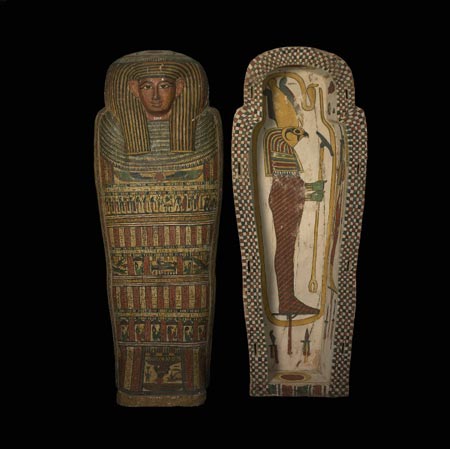
Figure 11: Base and chapeau of an anthropoid outer coffin of Seshepenmehyt. © The Trustees of the British Museum
Natron was added to castor oil to make a smokeless fuel, which immune Egyptian artisans to paint elaborate artworks inside ancient tombs without staining them with soot.
Natron is an ingredient for making a singled-out colour called Egyptian bluish and every bit the flux in Egyptian faience. It was used along with sand and lime in ceramic and glass-making by the Romans and others at to the lowest degree until 640 CE. The mineral was also employed as a flux to solder precious metals together.
They used a range of pigments to obtain the colours they wanted and they were responsible for the manufacture of synthetic pigments. Their pigments came mostly from the rocks and for binders they used mucilage arabic, egg and glue.
They created a ground for painting on by mixing calcite with glue arabic and painting that on to a surface. They painted on many surfaces including walls, statues of rock, forest alabaster, wood boxes, coffins, panels, papyrus and minor objects of many materials.
They as well adult the apply of linen and plaster as a painting medium in the form of cartonnage. Alternate layers of linen and plaster would be congenital upwardly to form a hard surface. This array of different surfaces or supports required the development of different techniques.
The influence of Egypt's religion on its art
To sympathise Egypt, and its art it is important to have some thought of the fashion the Ancient Egyptians interpreted their world. They developed a world view in which events and conditions were attributed to the actions of multiple, related gods and goddesses.
The Aboriginal Egyptians' earth view was influenced by their geography, the Nile and its annual flooding and the bountiful harvests the Nile gave the people of the river valley. They interpreted every occurrence in their lives in terms of the relationship between natural and supernatural forces in the following divisions:
Natural - The almanac bicycle of the river Nile'south overflowing, the rich fertile banks known as Kemet, the Blackness Lands, and the enormous size and unchanging harshness of the surrounding desert known as Desheret, the Red Lands. The Nile was, in antiquity, a very predictable river. Until the Aswan High Dam was built, Egypt received a yearly inundation between July and September, a season the Egyptians chosen akhet meaning overflowing.
The swollen Nile would flood its banks and spread blackness fertile muddy silt on to the land, hence "The Black Land". Without this black silt the land would exist arid. The amount of silt left backside depended on the height of the Nile flood and determined the amount of crops that the Egyptians could grow. If the inundation was also low it would exist a year of famine.
Angelic - The daily cycle of the sun'due south movement across the sky, that was symbolic of nascency, life, decease, and rebirth. Information technology was likewise associated with the motility of the stars and the patterns of the constellations.
The religious beliefs pervaded and ruled over the Aboriginal Egyptian society and their art. To capeesh this information technology is useful to understand their view of the link between the natural and celestial world.
Inundation and emergence
Egyptians saw the inundation as a yearly coming of the god Hapy, bringing fertility to the land. They used astronomy to predict and prepare for the inundation. At the fourth dimension of the inundation the "dog star" (Sirius) rose in the sky and continued to exist seen in the dark sky during the flood. The time of inundation marked the start of the Egyptian New Year. Ancient Egyptians divided their year into 12 months each of 30 days.
Their dependence upon the Nile proved a precarious existence especially since the climate could not exist depended upon, in fact i in v years the alluvion could be either too high or too low. The Egyptians therefore relied on the star, rather than the season, as the herald of both the New year's day and the yearly flood.
Later on the inundation came emergence, or planting fourth dimension, around October or November. This was followed by the growing or peret flavour during which the Egyptians connected to h2o their crops using an irrigation system of canals using the shaduf to raise h2o from the river to the banks of the Nile. (The shaduf is still in utilise in Arab republic of egypt today). This went on until the Dry fourth dimension around March or April, which became the harvest or shemu flavour.
During the overflowing there was piddling for the Egyptian farmer to do, and so rather than doing zippo for a whole season the Egyptians would do other tasks in the form of working on edifice pyramids, temples and tombs. This way they avoided paying tax. Tax was usually taken out of the crops that the farmers grew, and during alluvion the farmland was covered past water.
sandersrappostion.blogspot.com
Source: https://edu.rsc.org/resources/egyptian-art/1618.article
Belum ada Komentar untuk "How Do Depictions of Royalty Differ From Those of Others in Ancient Egyptian Art"
Posting Komentar