Between the World and Me Memoir Book Review
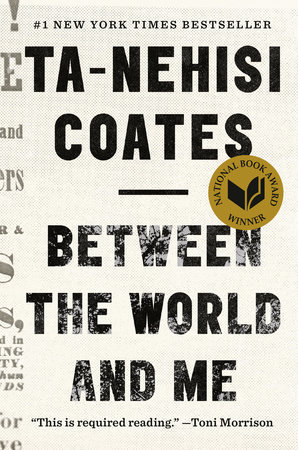
Between the World and Me
By Ta-Nehisi Coates
#1NEW YORK TIMESBESTSELLER • NATIONAL BOOK Honor WINNER • NAMED ONE OFTIME'S X Best NONFICTION BOOKS OF THE DECADE • PULITZER PRIZE FINALIST • NATIONAL BOOK CRITICS CIRCLE Award FINALIST • I OF OPRAH'S "BOOKS THAT HELP ME THROUGH" •At present AN HBO ORIGINAL SPECIAL EVENT
Hailed by Toni Morrison as "required reading," a bold and personal literary exploration of America's racial history by "the virtually important essayist in a generation and a writer who changed the national political chat about race" (Rolling Stone)
NAMED ONE OF THE MOST INFLUENTIAL BOOKS OF THE DECADE BY CNN• NAMED ONE OF PASTE 'S BEST MEMOIRS OF THE DECADE • NAMED Ane OF THE X BEST BOOKS OF THE Twelvemonth BYThe New York Times Book Review • O: The Oprah Magazine • The Washington Post • People • Entertainment Weekly • Vogue • Los Angeles Times • San Francisco Chronicle • Chicago Tribune • New York • Newsday • Library Periodical • Publishers Weekly
In a profound piece of work that pivots from the biggest questions about American history and ethics to the most intimate concerns of a father for his son, Ta-Nehisi Coates offers a powerful new framework for understanding our nation's history and electric current crisis. Americans have built an empire on the idea of "race," a falsehood that damages us all but falls nearly heavily on the bodies of black women and men—bodies exploited through slavery and segregation, and, today, threatened, locked upwardly, and murdered out of all proportion. What is it like to inhabit a black torso and notice a way to alive within information technology? And how tin can we all honestly reckon with this fraught history and gratis ourselves from its burden?
Between the World and Meis Ta-Nehisi Coates's effort to reply these questions in a letter to his adolescent son. Coates shares with his son—and readers—the story of his awakening to the truth about his identify in the world through a series of revelatory experiences, from Howard Academy to Civil State of war battlefields, from the Due south Side of Chicago to Paris, from his childhood abode to the living rooms of mothers whose children's lives were taken as American plunder. Beautifully woven from personal narrative, reimagined history, and fresh, emotionally charged reportage,Between the World and Meclearly illuminates the by, bracingly confronts our present, and offers a transcendent vision for a way forrad.
Praise
"I've been wondering who might fill up the intellectual void that plagued me later on James Baldwin died. Clearly it is Ta-Nehisi Coates. The linguistic communication of Between the World and Me, like Coates's journey, is visceral, eloquent, and beautifully redemptive. And its exam of the hazards and hopes of black male life is as profound equally information technology is revelatory. This is required reading."—Toni Morrison
"Powerful and passionate . . . profoundly moving . . . a searing meditation on what it means to be black in America today."—Michiko Kakutani, The New York Times
"Really powerful and emotional."—John Fable, The Wall Street Journal
"Boggling . . . [Coates] writes an impassioned letter to his teenage son—a letter both loving and full of a parent'south dread—counseling him on the history of American violence confronting the blackness body, the young African-American'southward extreme vulnerability to wrongful arrest, police violence, and disproportionate incarceration."—David Remnick, The New Yorker
"Brilliant . . . a riveting meditation on the state of race in America . . . [Coates] is firing on all cylinders, and it is something to behold: a mature writer entirely consumed by a momentous subject and working at the extreme of his considerable powers at the very moment national events virtually arrange to his vision."—The Washington Post
"An eloquent blend of history, reportage, and memoir written in the tradition of James Baldwin with echoes of Ralph Ellison'southward Invisible Man . . . It is less a typical memoir of a particular fourth dimension and place than an autobiography of the black body in America. . . . Coates writes with tenderness, especially of his wife, child, and extended family, and with frankness. . . . Coates's success, in this volume and elsewhere, is due to his lucidity and innate nobility, his respect for himself and for others. He refuses to preach or talk downwardly to white readers or to plead for acceptance: He never wonders why nosotros just tin can't all get along. He knows government policies make getting along nigh incommunicable."—The Boston Globe
"For someone who proudly calls himself an atheist, Coates gives us a whole lot of 'Can I become an amen?' in this slim and essential volume of familial joy and rigorous struggle. . . . [He] has become the most sought-afterward public intellectual on the issue of race in America, with good reason. Between the World and Me . . . is at one time a magnification and a distillation of our being as black people in a country we were not meant to survive. It is a directly tribute to our forcefulness, endurance and grace. . . . [Coates] speaks resolutely and vividly to all of black America."—Los Angeles Times
"A crucial book during this moment of generational enkindling."—The New Yorker
"A work that's both titanic and timely, Between the Earth and Me is the latest essential reading in America's social canon."—Amusement Weekly
"Coates delivers a cute lyrical call for consciousness in the face of racial bigotry in America. . . . Between the World and Me is in the aforementioned style of The Burn down Next Time; it is a book designed to wake you up. . . . An exhortation confronting blindness."—The Guardian
"Coates has crafted a deeply moving and poignant letter to his own son. . . . [His] book is a compelling mix of history, assay and memoir. Between the Globe and Me is a much-needed artifact to document the times nosotros are living in [from] one of the leading public intellectuals of our generation. . . . The experience of having a sage elder speak directly to you in such lyrical, gorgeous prose—language bursting with the revelatory thought and love of blackness life—is a cute thing."—The Root
"Rife with dear, sadness, anger and struggle, Between the World and Me charts a path through the American gauntlet for both the black child who will inevitably walk the globe solitary and for the blackness parent who must permit that kid walk away."—Newsday
"Poignant, revelatory and exceedingly wise, Between the World and Me is an essential clarion call to our commonage conscience. Nosotros ignore information technology at our own peril."—San Francisco Chronicle
"Masterfully written . . . powerful storytelling."—New York Post
"One of the almost riveting and heartfelt books to appear in some time . . . The book achieves a level of clarity and eloquence reminiscent of Ralph Ellison'south classic Invisible Man. . . . The perspective [Coates] brings to American life is one that no responsible citizen or serious scholar tin can safely ignore."—Foreign Affairs
"Urgent, lyrical, and devastating in its precision, Coates has penned a new classic of our fourth dimension."—Vogue
"Powerful."—The Economist
"A work of rare beauty and revelatory honesty . . . Between the World and Me is a love letter written in a moral emergency, one that Coates exposes with the precision of an autopsy and the force of an exorcism. . . . Coates is frequently lauded as one of America'southward nearly of import writers on the subject of race today, but this in fact undersells him: Coates is one of America's most of import writers on the subject of America today. . . . [He's] a polymath whose latitude of noesis on matters ranging from literature to popular culture to French philosophy to the Ceremonious War bleeds through every page of his book, distilled into profound moments of discovery, immensely erudite but never showy."—Slate
"The most important book I've read in years . . . an illuminating, edifying, educational, inspiring feel."—Smithsonian Asian Pacific American Center
"Information technology's an indescribably enlightening, enraging, of import certificate about being black in America today. Coates is perhaps the best we take, and this book is mayhap the best he's always been."—Deadspin
"Vital reading at this moment in America."—U.S. News & Globe Report
"[Coates] has crafted a highly provocative, thoughtfully presented, and beautifully written narrative. . . . Much of what Coates writes may be difficult for a majority of Americans to process, but that'south the incisive wisdom of information technology. Read it, call back about it, take a deep breath and read it again. The spirit of James Baldwin lives within its pages."—The Christian Science Monitor
"Part memoir, role diary, and wholly necessary, it is precisely the document this country needs right now."—New Republic
"A moving testament to what it means to be black and an American in our troubled age . . . Between the World and Me feels of-the-moment, just like James Baldwin's celebrated 1963 treatise The Fire Side by side Time, it stands to become a archetype on the subject of race in America."—The Seattle Times
"Riveting . . . Coates delivers a fiery soliloquy dissecting the tradition of the erasure of African-Americans offset with the securely personal."—Minneapolis Star Tribune
"[Between the World and Me] is not a Pollyanna, coming-of-age memoir nigh how idyllic life was growing upward in America. It is raw. It is searing. . . . [It'due south] a book that should be read and shared by everyone, as information technology is a story that painfully and honestly explores the age-old question of what it means to grow up black and male in America."—The Baltimore Sun
"A searing indictment of America'south legacy of violence, institutional and otherwise, against blacks."—Chicago Tribune
"I know that this book is addressed to the author's son, and by obvious analogy to all boys and young men of color as they pass, inexorably, into harm's way. I hope that I will be forgiven, then, for feeling that Ta-Nehisi Coates was speaking to me, too, one father to another, teaching me that real courage is the courage to be vulnerable, to admit having fallen short of the mark, to stay open up-hearted and curious in the face of hate and lies, to remain skeptical when there is so much comfort in easy conventionalities, to acknowledge the limits of our power to protect our children from harm and, hardest of all, to encounter how the burden of our need to protect becomes a burden on them, ane that we must, sooner or later, take the wisdom and the atrocious courage to surrender."—Michael Chabon
"Ta-Nehisi Coates is the James Baldwin of our era, and this is his cri de coeur. A bright thinker at the superlative of his powers, he has distilled four hundred years of history and his own anguish and wisdom into a prayer for his beloved son and an invocation to the conscience of his land. Betwixt the World and Me is an instant archetype and a gift to us all."—Isabel Wilkerson, writer of The Warmth of Other Suns
Excerpt
I.
. . . we sprawl in gray chains in a identify total of winters when what nosotros desire is the sunday
Amira Baraka, "Ka Ba"
Son,
Last Lord's day the host of a popular news prove asked me what it meant to lose my body. The host was dissemination from Washington, D.C., and I was seated in a remote studio on the far due west side of Manhattan. A satellite closed the miles betwixt united states of america, merely no machinery could shut the gap between her world and the world for which I had been summoned to speak. When the host asked me almost my body, her face faded from the screen, and was replaced by a roll of words, written past me before that calendar week.
The host read these words for the audition, and when she finished she turned to the subject of my torso, although she did not mention information technology specifically. Only by at present I am accustomed to intelligent people request near the condition of my body without realizing the nature of their request. Specifically, the host wished to know why I felt that white America'due south progress, or rather the progress of those Americans who believe that they are white, was built on looting and violence. Hearing this, I felt an quondam and indistinct sadness well up in me. The answer to this question is the record of the believers themselves. The answer is American history.
There is nothing extreme in this statement. Americans deify commonwealth in a way that allows for a dim awareness that they have, from time to time, stood in defiance of their God. Only commonwealth is a forgiving God and America'south heresies—torture, theft, enslavement—are and so common amidst individuals and nations that none can declare themselves immune. In fact, Americans, in a real sense, have never betrayed their God. When Abraham Lincoln declared, in 1863, that the boxing of Gettysburg must ensure "that government of the people, past the people, for the people, shall not perish from the world," he was not merely being aspirational; at the onset of the Civil War, the U.s. had one of the highest rates of suffrage in the globe. The question is not whether Lincoln truly meant "government of the people" just what our land has, throughout its history, taken the political term "people" to actually mean. In 1863 it did non hateful your mother or your grandmother, and information technology did non mean y'all and me. Thus America's problem is not its betrayal of "regime of the people," just the means by which "the people" caused their names.
This leads us to another equally of import ideal, one that Americans implicitly have but to which they make no conscious claim. Americans believe in the reality of "race" as a defined, indubitable feature of the natural world. Racism—the need to accredit bone-deep features to people and then humiliate, reduce, and destroy them—inevitably follows from this inalterable condition. In this mode, racism is rendered equally the innocent girl of Mother Nature, and i is left to deplore the Eye Passage or the Trail of Tears the way one deplores an convulsion, a tornado, or any other phenomenon that can be cast as beyond the handiwork of men.
Only race is the child of racism, not the father. And the process of naming "the people" has never been a matter of genealogy and physiognomy so much as i of hierarchy. Difference in hue and hair is old. But the belief in the preeminence of hue and pilus, the notion that these factors can correctly organize a society and that they signify deeper attributes, which are indelible—this is the new thought at the centre of this new people who have been brought up hopelessly, tragically, deceitfully, to believe that they are white.
These new people are, like us, a modernistic invention. But dissimilar united states of america, their new proper name has no real meaning divorced from the mechanism of criminal ability. The new people were something else before they were white—Cosmic, Corsican, Welsh, Mennonite, Jewish—and if all our national hopes have any fulfillment, then they will take to exist something else again. Perhaps they volition truly become American and create a nobler basis for their myths. I cannot call it. As for now, it must be said that the process of washing the disparate tribes white, the elevation of the conventionalities in being white, was non achieved through vino tastings and water ice cream socials, but rather through the pillaging of life, freedom, labor, and state; through the flaying of backs; the chaining of limbs; the strangling of dissidents; the destruction of families; the rape of mothers; the sale of children; and various other acts meant, showtime and foremost, to deny you and me the right to secure and govern our own bodies.
The new people are non original in this. Perchance there has been, at some signal in history, some great power whose elevation was exempt from the vehement exploitation of other homo bodies. If at that place has been, I have yet to notice it. Simply this boiler of violence tin never excuse America, because America makes no claim to the banal. America believes itself exceptional, the greatest and noblest nation always to exist, a lone champion standing betwixt the white city of commonwealth and the terrorists, despots, barbarians, and other enemies of civilization. One cannot, at once, claim to be superhuman and so plead mortal error. I suggest to take our countrymen'south claims of American exceptionalism seriously, which is to say I advise subjecting our country to an exceptional moral standard. This is difficult because there exists, all effectually us, an apparatus urging us to take American innocence at face up value and not to inquire too much. And it is so easy to wait abroad, to live with the fruits of our history and to ignore the great evil washed in all of our names. Only you and I have never truly had that luxury. I think you know.
I write you in your fifteenth year. I am writing y'all because this was the yr you saw Eric Garner choked to death for selling cigarettes; because y'all know now that Renisha McBride was shot for seeking help, that John Crawford was shot down for browsing in a section store. And y'all have seen men in uniform drive by and murder Tamir Rice, a twelve-twelvemonth-old child whom they were oath-bound to protect. And yous have seen men in the same uniforms pummel Marlene Pinnock, someone's grandmother, on the side of a route. And you know at present, if yous did non before, that the police departments of your country have been endowed with the authority to destroy your body. Information technology does non affair if the destruction is the result of an unfortunate overreaction. Information technology does not matter if it originates in a misunderstanding. It does non matter if the devastation springs from a foolish policy. Sell cigarettes without the proper authority and your body can be destroyed. Resent the people trying to entrap your body and it tin exist destroyed. Turn into a dark stairwell and your body tin can exist destroyed. The destroyers volition rarely be held answerable. By and large they will receive pensions. And destruction is merely the superlative grade of a rule whose prerogatives include friskings, detainings, beatings, and humiliations. All of this is mutual to black people. And all of this is old for black people. No 1 is held responsible.
There is nothing uniquely evil in these destroyers or even in this moment. The destroyers are only men enforcing the whims of our state, correctly interpreting its heritage and legacy. It is hard to face this. Simply all our phrasing—race relations, racial chasm, racial justice, racial profiling, white privilege, even white supremacy—serves to obscure that racism is a visceral experience, that it dislodges brains, blocks airways, rips musculus, extracts organs, cracks bones, breaks teeth. You lot must never wait away from this. Yous must always remember that the sociology, the history, the economics, the graphs, the charts, the regressions all country, with great violence, upon the body.
That Sunday, with that host, on that news bear witness, I tried to explain this as best I could inside the time allotted. Just at the end of the segment, the host flashed a widely shared moving picture of an eleven-year-one-time blackness male child tearfully hugging a white law officer. And so she asked me about "promise." And I knew then that I had failed. And I remembered that I had expected to neglect. And I wondered again at the indistinct sadness welling up in me. Why exactly was I sad? I came out of the studio and walked for a while. It was a calm Dec twenty-four hour period. Families, believing themselves white, were out on the streets. Infants, raised to be white, were bundled in strollers. And I was sad for these people, much as I was sad for the host and sad for all the people out there watching and reveling in a specious hope. I realized then why I was pitiful. When the journalist asked me about my body, information technology was like she was asking me to awaken her from the most gorgeous dream. I accept seen that dream all my life. It is perfect houses with nice lawns. It is Memorial Day cookouts, cake associations, and driveways. The Dream is treehouses and the Cub Scouts. The Dream smells similar peppermint but tastes like strawberry shortcake. And for so long I have wanted to escape into the Dream, to fold my country over my caput like a blanket. Merely this has never been an option because the Dream rests on our backs, the bedding made from our bodies. And knowing this, knowing that the Dream persists by warring with the known world, I was lamentable for the host, I was sad for all those families, I was sad for my country, merely above all, in that moment, I was sorry for you.
That was the calendar week you learned that the killers of Michael Brown would go free. The men who had left his body in the street like some awesome annunciation of their inviolable power would never be punished. It was non my expectation that anyone would ever exist punished. Only y'all were young and however believed. You stayed upwardly till xi p.m. that night, waiting for the announcement of an indictment, and when instead it was appear that there was none yous said, "I've got to become," and you went into your room, and I heard you crying. I came in v minutes after, and I didn't hug you lot, and I didn't comfort you, because I thought it would be wrong to condolement you. I did not tell you that it would be okay, because I have never believed information technology would be okay. What I told you is what your grandparents tried to tell me: that this is your state, that this is your world, that this is your torso, and you must find some way to live within the all of it. I tell you lot at present that the question of how 1 should live within a black body, within a country lost in the Dream, is the question of my life, and the pursuit of this question, I take plant, ultimately answers itself.
This must seem foreign to you. Nosotros live in a "goal-oriented" era. Our media vocabulary is full of hot takes, large ideas, and grand theories of everything. Simply some fourth dimension ago I rejected magic in all its forms. This rejection was a souvenir from your grandparents, who never tried to console me with ideas of an afterlife and were skeptical of preordained American glory. In accepting both the anarchy of history and the fact of my total end, I was freed to truly consider how I wished to alive—specifically, how do I live free in this black trunk? It is a profound question because America understands itself as God's handiwork, only the black body is the clearest prove that America is the piece of work of men. I take asked the question through my reading and writings, through the music of my youth, through arguments with your grandfather, with your mother, your aunt Janai, your uncle Ben. I have searched for answers in nationalist myth, in classrooms, out on the streets, and on other continents. The question is unanswerable, which is non to say futile. The greatest reward of this constant interrogation, of confrontation with the brutality of my country, is that information technology has freed me from ghosts and girded me against the sheer terror of disembodiment.
And I am afraid. I experience the fear about acutely whenever you leave me. But I was afraid long before you, and in this I was unoriginal. When I was your age the only people I knew were black, and all of them were powerfully, adamantly, dangerously afraid. I had seen this fearfulness all my young life, though I had not always recognized it equally such.
It was e'er correct in forepart of me. The fright was there in the extravagant boys of my neighborhood, in their large rings and medallions, their large puffy coats and full-length fur-collared leathers, which was their armor against their world. They would stand on the corner of Gwynn Oak and Freedom, or Common cold Spring and Park Heights, or outside Mondawmin Mall, with their hands dipped in Russell sweats. I think back on those boys at present and all I come across is fear, and all I encounter is them girding themselves against the ghosts of the bad quondam days when the Mississippi mob gathered 'circular their grandfathers so that the branches of the black body might be torched, then cut abroad. The fearfulness lived on in their adept bop, their slouching denim, their large T‑shirts, the calculated angle of their baseball game caps, a catalog of behaviors and garments enlisted to inspire the belief that these boys were in firm possession of everything they desired.
I saw it in their customs of war. I was no older than five, sitting out on the front end steps of my home on Woodbrook Avenue, watching ii shirtless boys circumvolve each other close and buck shoulders. From and then on, I knew that there was a ritual to a street fight, bylaws and codes that, in their very need, attested to all the vulnerability of the black teenage bodies.
I heard the fear in the starting time music I e'er knew, the music that pumped from nail boxes full of one thousand boast and bluster. The boys who stood out on Garrison and Freedom upwards on Park Heights loved this music considering information technology told them, against all prove and odds, that they were masters of their own lives, their ain streets, and their own bodies. I saw it in the girls, in their loud laughter, in their gilded bamboo earrings that announced their names thrice over. And I saw information technology in their barbarous language and hard gaze, how they would cut you with their eyes and destroy you with their words for the sin of playing as well much. "Go along my name out your mouth," they would say. I would watch them after school, how they squared off like boxers, vaselined up, earrings off, Reeboks on, and leaped at each other.
sandersrappostion.blogspot.com
Source: https://www.oneworldlit.com/books/between-the-world-and-me-hc
Belum ada Komentar untuk "Between the World and Me Memoir Book Review"
Posting Komentar